.png?width=200&height=98&name=Horizontal%20PVFARM%20Logo%20(Small).png)
Low Voltage
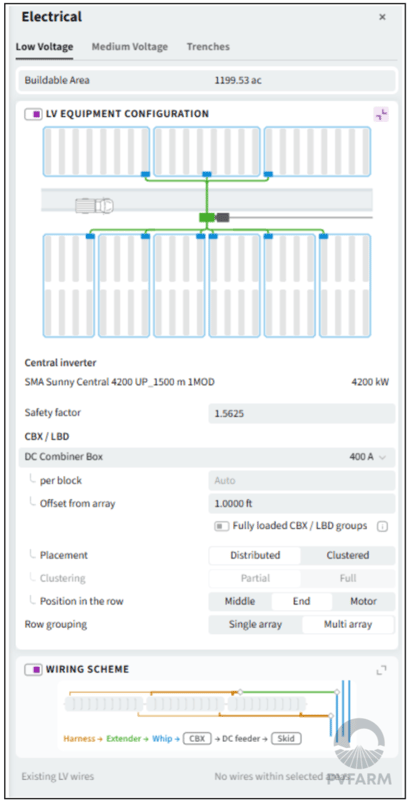
The Low Voltage tab within the Electrical panel is divided into two sections: LV Equipment Configuration and Wiring Scheme.
The LV Equipment Configuration section defines the placement of the LBDs and CBXs, as well as how they are connected to the SATs. The Wiring Scheme section allows you to configure the parameters used to generate the low-voltage wiring.
Each workflow can be run independently using the available toggles.
-
Selected Area – Defines the parcels where PVFARM will apply the selected CBX, LBD, equipment, and wiring configurations.
-
LV Equipment Configuration – Allows you to select the DC equipment and define the corresponding layout options.
-
Wiring Scheme – Provides multiple configuration options for generating different low-voltage wiring layouts and schematics.
LV Equipment Configuration
-
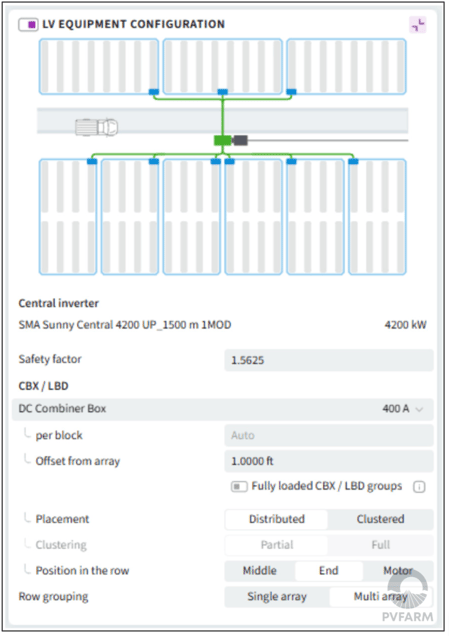
Combiner Box – Selects the DC combiner box model to be used in the low-voltage design.
-
Per block - You can now specify the number of combiner boxes per block or leave the field in Auto mode to let PVFARM handle grouping automatically.
-
Offset from Array – Defines the distance between the combiner box and the end of the array table.
-
Safety Factor – Specifies the factor used when grouping circuits within the combiner boxes.
-
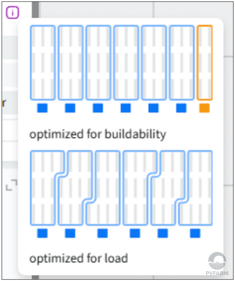
Fully Loaded CBs – Click the "i" icon to view the corresponding illustration and additional details.
-
CB Placement Strategy – Defines how the combiner boxes will be distributed throughout the layout.
-
Clustering – Determines the strategy used to group combiner boxes when clustered placement is selected.
-
Position in the Row – Defines the combiner box position relative to the array. The box can be placed at the end, in the middle, or at the motor pile.
-
Row Grouping – Defines the number of array rows included vertically within each low-voltage equipment configuration.
Single Array
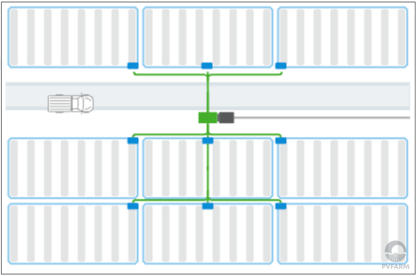
Multi-Array
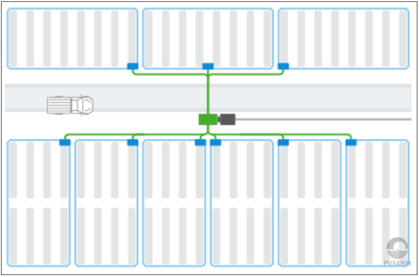
Refer to “Equipment Placement and Wiring Scheme Options” for more information on CBX and LBD placement.
Wiring Schemes
Refer to “Equipment Placement and Wiring Scheme Options” for a detailed overview of the available low-voltage wiring configurations.
-
Wiring Schemes– Selects the LV wiring pattern to be applied to the layout and used for conductor selection. PVFARM supports five LV wiring configurations.
- Conductor Temperature – Defines the conductor temperature used when sizing cables based on voltage drop.
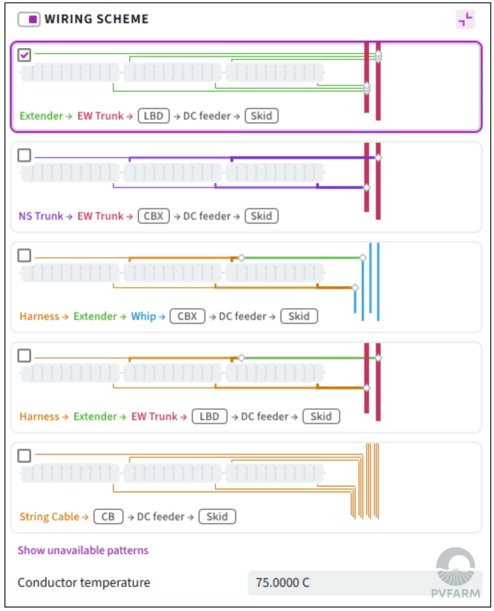
When "Set Wire Gauges by" is set to Voltage Drop:
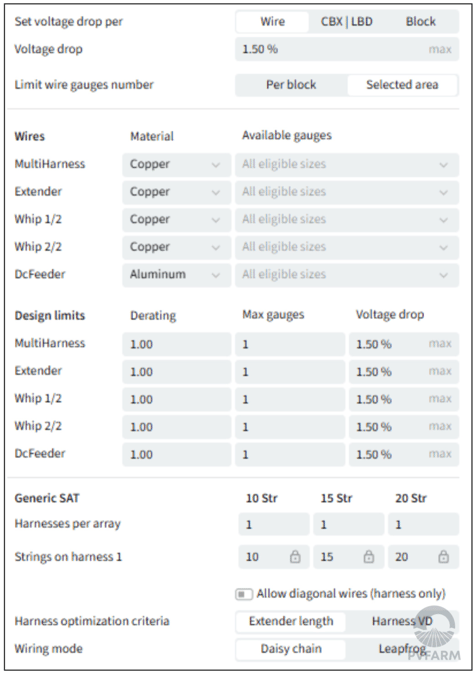
- Select voltage drop per: Choose whether voltage-drop requirements apply per wire, per CBX/LBD circuit, or per block.
- Voltage drop: Set the global maximum voltage drop for the LV wiring design.
- Limit wire gauges number: Choose whether the limit on the number of different wire gauges applies per block or across the selected area.
- Wires: For each wire type in the selected wiring scheme, choose the conductor material and the wire gauges PVFARM can consider during cable-sizing calculations. If no gauges are selected, PVFARM considers all eligible sizes available in the catalog.
- Design limits — Derating: Set a derating factor for each wire type that PVFARM will account for when selecting cable sizes.
- Design limits — Max gauges: Specify the maximum number of different gauges allowed for each wire type. PVFARM optimizes cable sizing within this limit, applied per block or across the selected area.
- Design limits — Voltage drop: Set a maximum voltage drop for each wire type. This value overrides the global voltage-drop setting for that wire type.
When using a harness-based wiring scheme, you can also configure:
- Harnesses per array: Set the number of harnesses for each row size.
- Strings on harness 1, 2, …: Specify how many strings connect to each harness.
- Harness optimization criteria: Choose between minimizing extender cable length and minimizing harness voltage drop. Selecting Harness VD places higher-current harnesses closer to the combiner box to reduce voltage drop, which may increase extender cable length. Selecting Extender length prioritizes shorter extender cables.

-
Enable Wire Offset – Separates the wires visually within the 3D model space.
- Hide Small (on-screen) wires – When enabled, string wires disappear as you zoom out, making the layout cleaner.
Medium Voltage
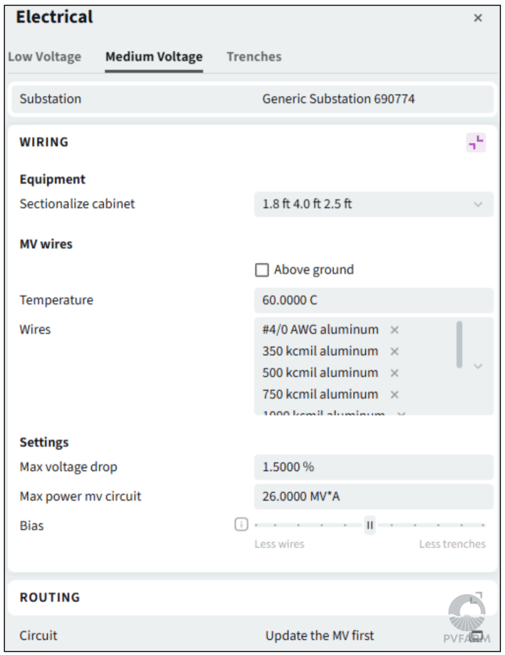
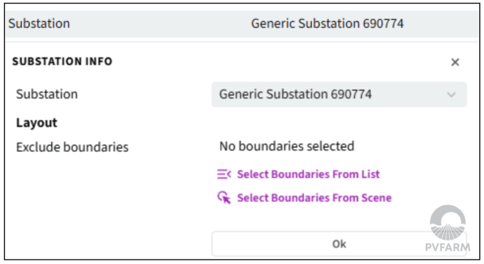
Substation Section
-
Select the project substations for which the medium-voltage network will be generated.
-
Excluded Boundaries – Select the boundaries through which medium-voltage circuits cannot be routed.
Wiring
Equipment
-
Sectionalizing Cabinet – Select the sectionalizing cabinet model to be used from the available project equipment.
MV Wires
-
Above Ground – Enable this option to route the medium-voltage conductors above ground.
-
Conductor Temperature – Defines the conductor temperature used in the medium-voltage cable calculations.
-
Wires – Select the conductor sizes that PVFARM may use when generating the medium-voltage network. Remove any conductor options that should not be considered.
Settings
-
Maximum Voltage Drop – Defines the maximum allowable average voltage drop for each medium-voltage circuit.
-
Maximum MV Circuit Power – Defines the maximum power that can be assigned to a medium-voltage circuit.
-
Bias – Adjusts the routing algorithm’s preference between reducing the amount of wire used and reducing the total trench length.
Routing
-
Waypoints: Waypoints are user-defined points added to the layout to influence the routing of nearby medium-voltage circuits. + Add Waypoint – Activates waypoint-creation mode. You can continue adding waypoints until you select OK.
-
Circuits: This section allows you to define which block numbers should be grouped within the same medium-voltage circuit. + Add Circuit – Creates a new circuit configuration with a dropdown menu. Select all blocks that should be included in that circuit.
Trenches
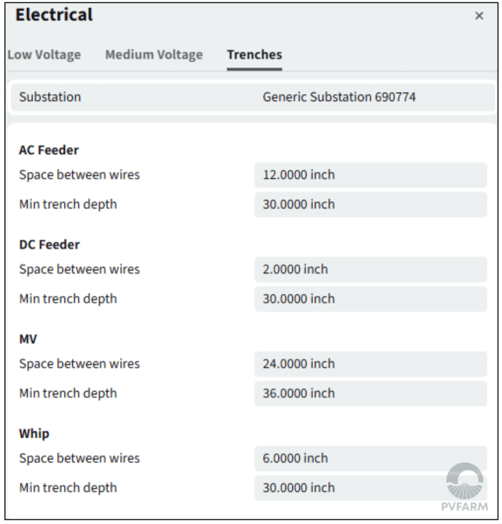
This section allows you to define the trench dimensions, including the spacing between conductors and the minimum trench depth. For additional information, refer to the “How Trenches Work” article.