.png?width=200&height=98&name=Horizontal%20PVFARM%20Logo%20(Small).png)
Pile Optimization is using the array pile lengths to determine the optimal amount of grading in your project.
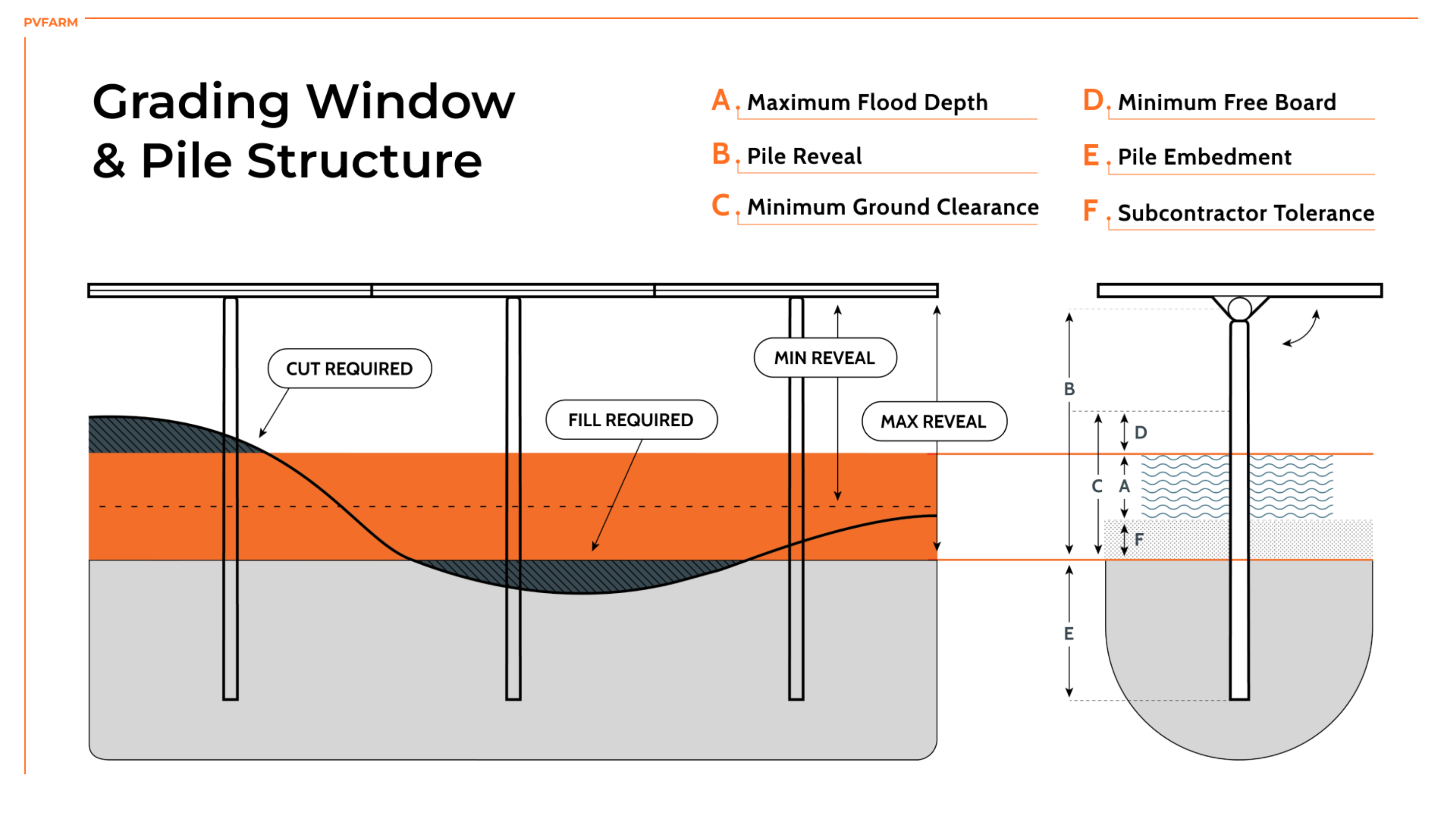
Pile optimization has the following parameters:
-
Max slope is the permissible slope of the tracker, in percent:
For rigid trackers: height difference between the outermost piles of the tracker / tracker length * 100%
For terrain following trackers: height difference between adjacent piles / bay length * 100%
-
Min pile reveal is the minimum required height from the surface to the crossbar with modules
-
Max pile reveal - The difference in height between min reveal and max reveal is formed due to the tolerance of the ground surface during grading surface:
max pile reveal = min pile reveal + 2 * tolerance
When solving for max reveal the solver will iterate based on max equipment slope to limit the maximum reveal in a given row
-
Min pile embedment is the minimum height of a pile to which it must be driven into the ground to ensure a given load-bearing capacity
- Clearance to grade - The solver can be given a clearance to grade from the module leading edge. When perform pile reveal and cut and fill the solvers will maintain this clearance along the edge of the trackers and fixed tilt tables.
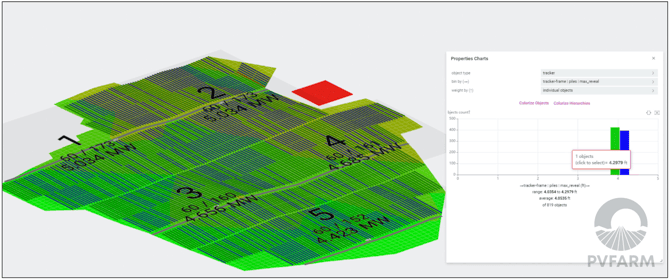
Example 1
Let's perform a Cut&Fill with tolerance = 0 ft and min pile reveal = 4 ft.
max pile reveal = min pile reveal + 2 * tolerance = 4 ft + 2 * 0 ft = 4 ft.
For 99% of trackers, this is what we get.
But since we always have an error in the Cut&Fill algorithm and the surface of the earth is discretized by a grid, we will always have a slight deviation for several trackers.
In this example, we got that one tracker exceeds the specified reveal by up to 0.3 ft.
Example 2
Let's perform a Cut&Fill with tolerance = 1 ft and min pile reveal = 4 ft.
max pile reveal = min pile reveal + 2 * tolerance = 4 ft + 2 * 1 ft = 6 ft.
From the sampling of the earth's surface by the grid and the error of the method, we have two trackers whose reveal exceeded the specified one by 1.8 ft.
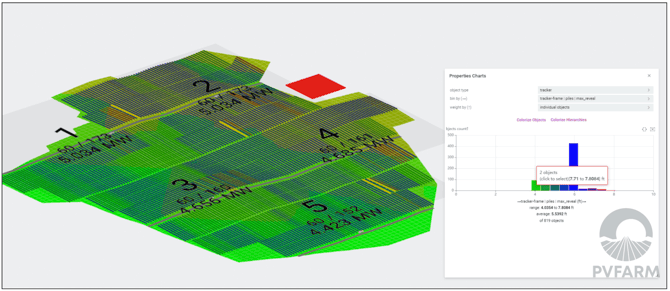
But if Cut&Fill is restarted in areas where there is a large error for the reveal, setting greater accuracy for the algorithm, then we will get a result with a smaller error for the reveal.