.png?width=200&height=98&name=Horizontal%20PVFARM%20Logo%20(Small).png)
Site geometry (coordinates of transformers, substations, and areas occupied by trackers) is divided into a triangular grid.
Input Site:
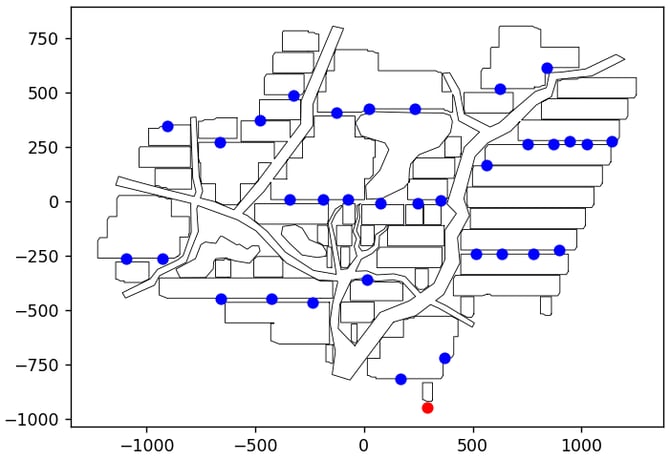
Mesh:
.png?width=670&height=466&name=Untitled%20(1).png)
A graph is built along the edges of this triangular grid. This graph is used to search for Steiner trees, i.e. a search is made for the shortest network connecting a given finite set of points in the plane. Thus, the shortest ways to connect the transformers to the substation are found.
After having trees (routes along which the cables go the shortest way), the cables are grouped into MV circuits, so as to minimize the total length of the cables. This procedure is carried out by an optimization method. Optimization criterion shortest overall length.
As a result, we get MV circuits and cable routes.
MV Circuit:
.png?width=670&height=342&name=Untitled%20(2).png)
At the final stage, for each route, a cable is selected, determined by gauge, based on the allowable current and voltage drop. Sectionalizing Cabinets are installed in places where two wires connect into one.